Things Your Wedding Photographer Sees That You Never Notice
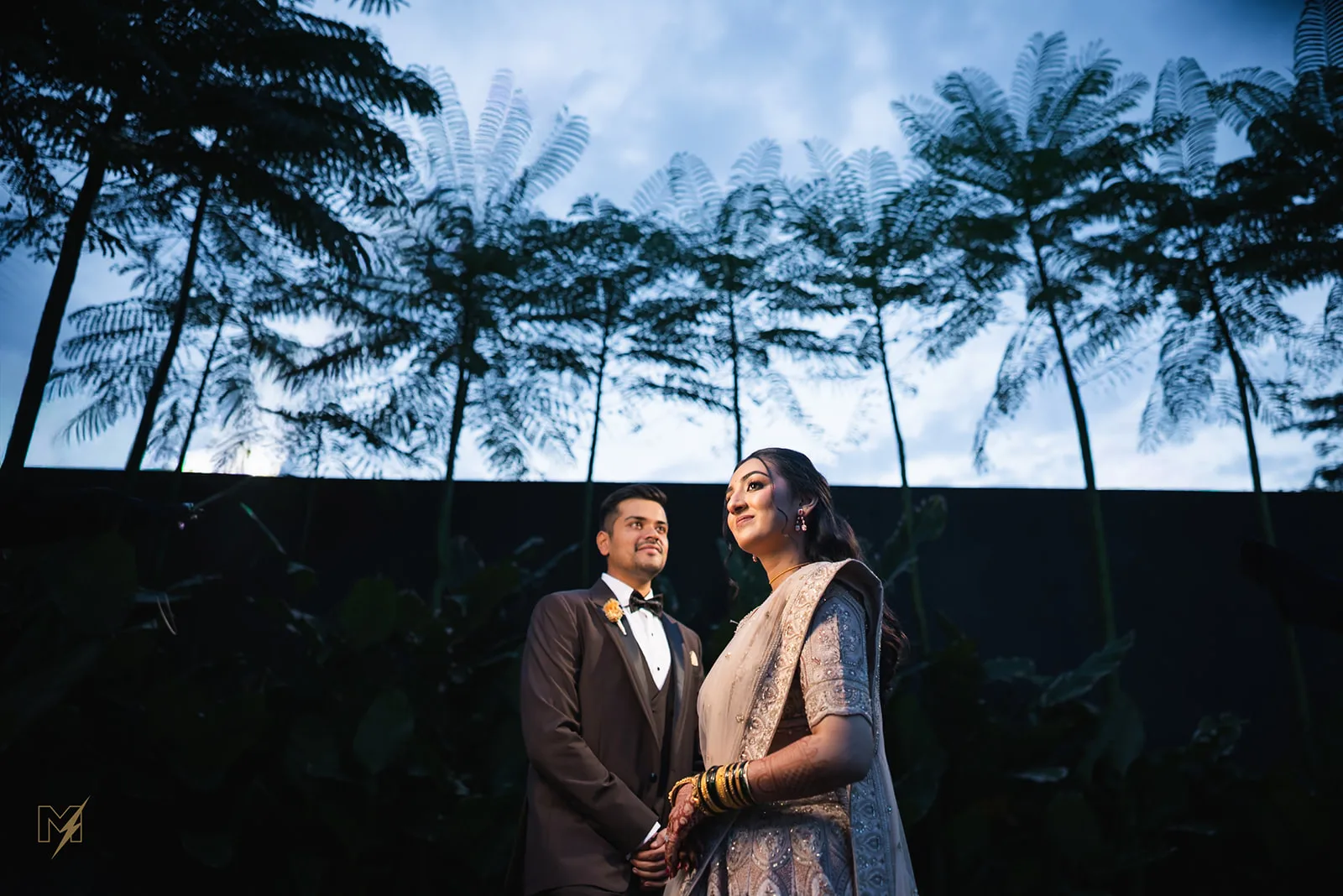
Outdoor Twilight Wedding Portrait of Bride in Silver Lehenga and Groom in Suit
A low angle outdoor wedding portrait taken during twilight featuring a couple looking off into the distance. The bride wears a heavily embroidered silver-grey lehenga with intricate detailing, gold bangles, and a delicate dupatta, while the groom stands slightly behind her in a sharp black tuxedo with a white shirt and bowtie. Silhouetted palm trees frame the top of the image against a cool-toned, soft sky, creating a dramatic and elegant backdrop.
What Your Wedding Photographer Notices That You Never Will, On your wedding day, you are probably thinking about everything except photography, You are wondering whether everyone has arrived. Whether the ceremony will start on time. Whether your outfit is sitting perfectly.
Whether your parents are enjoying themselves. Whether you remembered to speak to that one relative who travelled from another city.
Meanwhile, your wedding photographer is noticing an entirely different set of things, They are looking at the direction of light falling across your face.
They are watching the expression of your parents in the background, They are checking whether someone is about to walk into the frame.
They are anticipating a hug before it happens and looking for the right position to capture it, Most of these things will never cross your mind, And that is exactly what makes professional wedding photography different, A photographer is not simply looking at what is happening. They are constantly looking at how it can be photographed.
Light before everything else
One of the first things a professional wedding photographer notices is light.
You may walk into a beautifully decorated venue and immediately notice the flowers, stage, seating or décor.
A photographer notices where the light is coming from.
Is the light soft or harsh?
Is it coming from the front or behind the subject?
Will it create unwanted shadows?
Is the natural light better near the window?
Does the stage lighting affect skin tones?
These decisions can completely change the appearance of a photograph.
The same person standing in two different areas of the venue can look dramatically different depending on the available light.
This is why professional photographers often move around constantly during a wedding. They are not simply searching for different angles. They are searching for better light.
The background you never notice of wedding photographer
When you are standing with your family for a photograph, your attention is naturally on the people around you.
A photographer is also looking behind you.
They may notice a chair placed awkwardly in the frame, a wire running across the floor, an empty food table, a bright advertisement or someone standing directly behind the couple.
These details may seem insignificant in real life.
Inside a photograph, they can become distractions.
A professional photographer learns to recognise visual clutter quickly and either changes the angle, moves the subjects or waits for the background to become cleaner.
The goal is simple, Make sure the viewer looks at what matters.
The couple may not even notice them because they are busy participating in the ceremony.
A photographer is watching.
When a bride's father looks at her before the ceremony, when a mother smiles during a ritual or when the groom's friends react to something happening on stage, the photographer recognizes that these expressions may become meaningful photographs, This is where anticipation becomes an important part of wedding photography.
The photographer is not simply reacting to moments.
They are often trying to predict them.
The people standing outside the spotlight
Wedding photography is often associated with the couple.
But a wedding is much bigger than two people.
There are parents who have spent months preparing for the celebration. Grandparents who may have travelled long distances.
Friends who have known the couple for years. Siblings who have been involved in every preparation.
A photographer notices these people too.
Sometimes, the most meaningful photograph from a wedding is not the couple's portrait.
It could be a grandmother watching the ceremony.
A brother fixing his sister's outfit.
A father standing quietly while his daughter gets ready.
Friends laughing together during a break, These are the photographs that complete the wedding album because they show the people behind the celebration.
The moments happening outside the main event
The biggest wedding moments are usually easy to photograph.
Everyone knows when the ceremony begins.
Everyone knows when the couple exchanges garlands.
Everyone knows when the bride enters.
But a photographer also has to pay attention to everything happening around those major events.
The five minutes before the ceremony.
The conversation between two rituals.
The laughter backstage.
The family members waiting outside.
The couple walking from one location to another.
These transitional moments often produce some of the most natural photographs because people are less conscious of the camera.
The photographer knows that the wedding does not stop being interesting just because the main ceremony has ended.
Composition that happens almost instinctively
Composition is another thing couples rarely think about while getting photographed.
A photographer is constantly considering where every element sits inside the frame.
Should the couple be positioned in the centre?
Would the photograph look stronger with more space around them?
Is there symmetry in the architecture?
Can the photographer use the doorway as a natural frame?
Is there a reflection that could add depth?
Are there leading lines that can guide the viewer's eye?
These decisions may happen within seconds.
Good composition often looks effortless in the final photograph because the viewer does not see the decisions that created it, They simply see a balanced image.
Timing can change everything
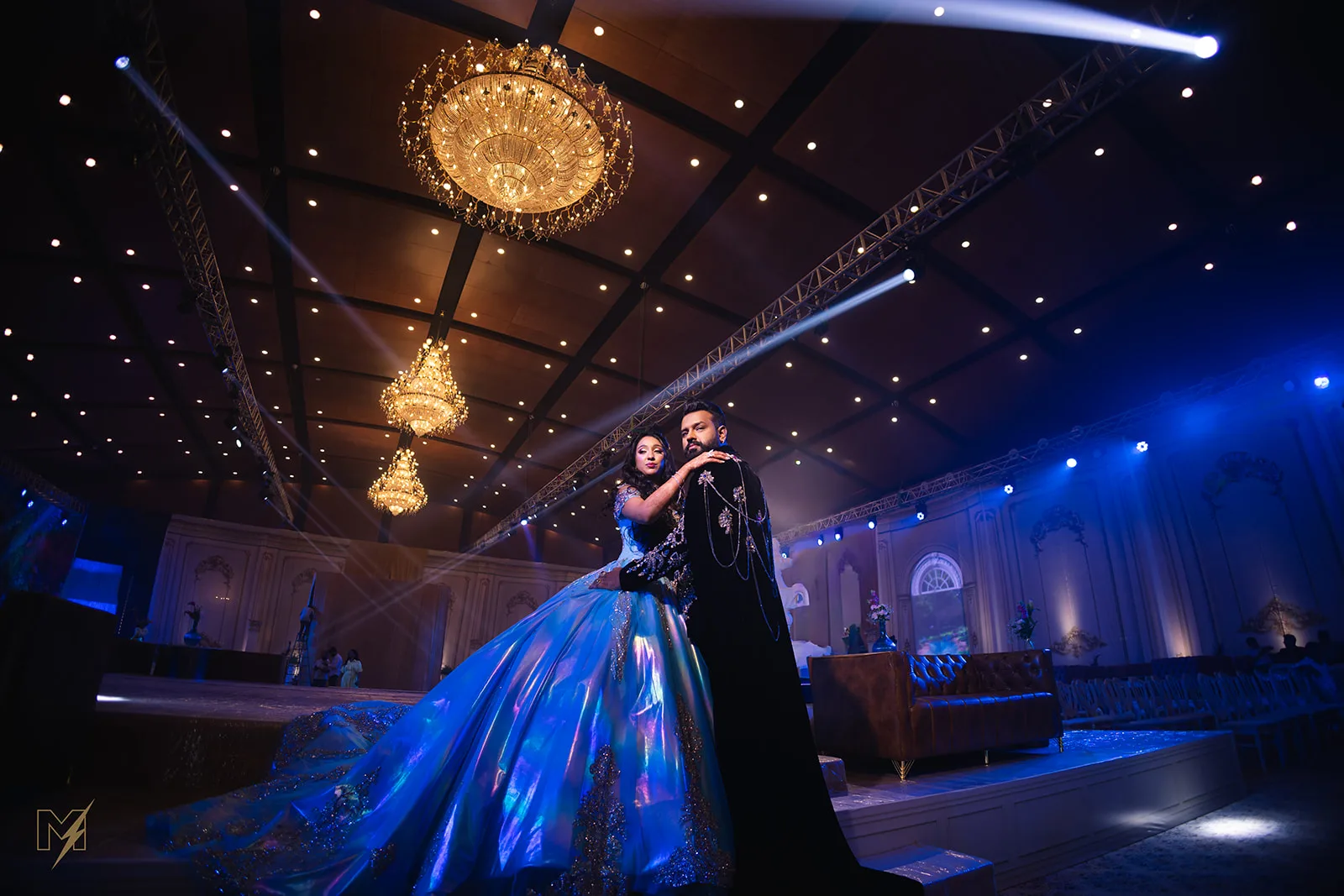
Grand Reception Couple Portrait in Blue Gown and Black Sherwani Under Chandeliers
A wide-angle, dramatic wedding reception photo of a couple standing on a spacious stage inside a grand hall. The bride wears a sweeping, metallic blue ballgown with golden embroidery along the skirt, embracing the groom, who stands beside her in a regal black sherwani with shoulder chain accents and embellished detailing. The high ceiling features multiple glowing crystal chandeliers, overhead spot lighting, and fairy lights, creating a cinematic and royal ambiance.
Two photographs taken one second apart can tell completely different stories.
A photographer knows this, During a wedding ritual, there may be a specific moment when hands meet, expressions change or an important action takes place, Capturing it too early may miss the emotion.
Capturing it too late may mean the moment is already gone.
This is why timing is one of the most important skills in wedding photography.
The camera has to be ready before the moment happens.
Waiting until something interesting happens and then reaching for the camera is often already too late.
Your body language tells a photographer a lot
You may think you are simply standing beside your partner.
A photographer sees posture, distance, movement and interaction.
Are you comfortable together?
Are you naturally leaning towards each other?
Are your hands relaxed?
Are you looking at each other or towards the camera?
During candid moments, body language can communicate emotions even when nobody is speaking, This is particularly important during couple portraits.
A good photographer may make small adjustments to positioning, not because the original pose is wrong, but because tiny changes can make the photograph feel more natural.
The difference between harsh light and flattering light
Lighting is not simply about whether a venue is bright or dark.
The quality and direction of light matter.
Harsh overhead lighting can create strong shadows under the eyes and nose.
Direct flash can sometimes produce a very different appearance from soft directional lighting.
Window light can create gentle highlights.
Backlighting can create separation between the subject and the background.
A photographer understands these differences and adapts accordingly, This becomes especially important during Indian weddings because photography conditions can change dramatically throughout the day.
A morning ceremony, an indoor reception and an evening outdoor portrait session may all require different approaches.
When not to take the photograph
Professional photography is also about knowing when to wait.
Not every moment needs a camera in someone's face.
If a parent is having a private emotional moment, the photographer may choose to maintain distance.
If guests are deeply involved in a conversation, interrupting them for a photograph may destroy the very moment worth capturing.
Sometimes, the best photograph comes from simply observing quietly, Knowing when to step forward and when to step back is an important part of documentary and candid wedding photography.
What you think is ordinary may be extraordinary later
There is something interesting about photographs.
The moments that feel ordinary today can become incredibly valuable years later.
You may not think much about a photograph of your friends laughing during your wedding, Years later, you may realise that some of those people have moved to different cities or countries.
A photograph of your grandparents may become one of the most precious photographs you own.
A simple picture of your parents watching you may suddenly carry a completely different meaning.
A wedding photographer cannot know which photograph will become your favourite years from now.
That is why they pay attention to more than just the obvious moments, They photograph the details, the people and the emotions that make your wedding uniquely yours.
Why experience matters in wedding photography
A camera can capture an image, Experience helps determine which image is worth capturing, Professional wedding photography involves much more than technical knowledge of cameras and lenses.
It requires understanding light, people, timing, composition, movement and emotion.
It also requires staying alert for hours.
A wedding photographer may photograph hundreds or thousands of frames during one celebration, but the goal is not simply to create a large number of photographs.
The goal is to create meaningful ones.
Experience helps the photographer make decisions quickly without making the couple feel like they are constantly being directed.
Your photographer sees the wedding differently
For you, the wedding is something you are experiencing.
For the photographer, it is something they are observing and documenting at the same time, You see your entrance.
They see your expression, your parents' reaction, your friends in the background and the light coming through the entrance.
You see your partner during the ceremony.
They see the way you look at each other, the people watching behind you and the moment when your expressions change.
You see a celebration, They see hundreds of small visual moments happening simultaneously.
That difference in perspective is what makes professional wedding photography valuable.
The best photographs are often the ones you never knew happened
At the end of the wedding, you will remember the major events, But when you receive your photographs, you may discover moments you never even knew existed.
Your mother smiling from across the room.
Your friends celebrating when you entered.
Your grandparents watching the ceremony.
Your partner laughing when you were not looking.
A quiet moment between your parents.
These photographs can become some of the most treasured images in your album precisely because you did not know they were happening, That is what your wedding photographer notices that you never will.
While you are busy living the day, they are watching the light, the people, the expressions, the details and the moments between everything else, And sometimes, the photograph you never knew was being taken becomes the photograph you never want to forget, Your wedding day happens once. Make sure the moments you miss are still remembered.
1. What does a wedding photographer look for during a wedding?
▼
A professional wedding photographer looks beyond the main ceremony. They observe lighting, composition, expressions, body language, backgrounds, family reactions, candid interactions and unexpected moments.
2. Why is lighting important in wedding photography?
▼
Lighting affects the mood, detail, skin tones and overall appearance of a photograph. Professional photographers assess the direction and quality of available light and adjust their position or equipment accordingly.
3. Do wedding photographers photograph guests as well as the couple?
▼
Yes. Guests, family members and friends are an important part of the wedding. Their reactions and interactions help document the atmosphere and relationships surrounding the couple.
4. How does a photographer capture candid wedding photos?
▼
Candid photography relies heavily on observation and anticipation. Instead of constantly directing people, the photographer watches for natural interactions and positions themselves to capture genuine moments without interrupting them.
5. Why should couples choose an experienced wedding photographer in Bangalore?
▼
Experience helps a photographer handle changing lighting, crowded venues, fast moving ceremonies and unpredictable moments. An experienced photographer can make quick creative and technical decisions while allowing the couple to enjoy their wedding naturally.
Ready to get started?
You live the moment. Your photographer notices the rest.